

Updated November 2026 · 5 min read
Cash vs accrual accounting is one of the first choices a new business owner faces. In the UAE, it now has tax consequences as well as reporting ones. The method decides when you record income and expenses. As a result, it changes your profit, your tax position and the way you read your numbers. Here is a plain guide to both methods, the UAE rules that shape the decision, and where accounting and bookkeeping services in Dubai fit in.
How Cash vs Accrual Accounting Differs
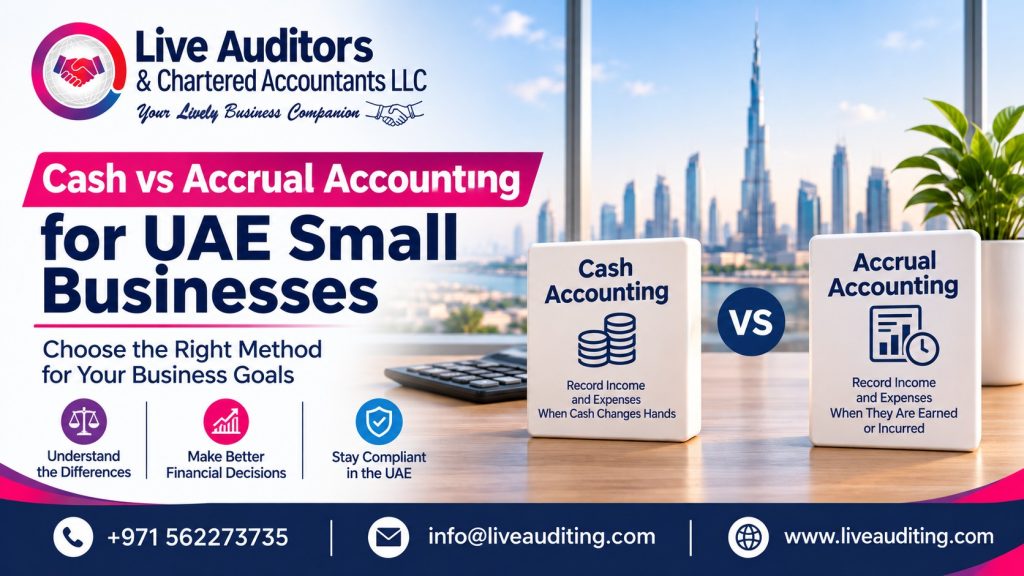
Under the cash method, you record income when money reaches your bank account and expenses when you pay them. It mirrors your bank statement, which is why many sole owners find it intuitive.
Under the accrual method, you record income when you earn it and expenses when you incur them, regardless of when cash moves. If you invoice a client in Business Bay in March and they pay in June, the revenue belongs to March.
Take a simple example. A design studio completes a AED 60,000 project in December but receives payment in February. On a cash basis, December looks like a poor month and February looks excellent. On an accrual basis, December shows the real result of the work done.
What UAE Corporate Tax Allows
UAE corporate tax starts from the accounting profit in your financial statements. Companies normally prepare those statements on an accrual basis under IFRS, so accrual is the default.
There is an exception for smaller businesses. Under a ministerial decision issued with the corporate tax rules, a business whose revenue does not exceed AED 3 million may generally prepare its financial statements on a cash basis for tax purposes. Others can apply to use cash accounting only in exceptional circumstances. If your revenue later exceeds the limit, you will need to move to accrual.
The detailed decisions and guides are published by the UAE Ministry of Finance, and it is worth checking the current text before you rely on any threshold. Small Business Relief is a separate election with its own revenue test and time limits. Do not confuse the two.
Why VAT Ignores Your Accounting Method
This is the point that catches many owners. Your choice of cash or accrual accounting does not change when VAT is due.
UAE VAT follows its own date of supply rules. Broadly, VAT becomes due on the earliest of three dates. These are delivery or completion, the date you issue a tax invoice, and the date you receive payment. So if you invoice in March and the customer pays in June, the output VAT usually belongs in March. This applies even on a cash basis.
This means a cash-basis business still needs to track invoices raised and invoices received. Many small firms keep cash books for profit but run a separate VAT register to stay compliant.
Pros and Cons for Small Businesses
Cash basis
The cash method is simple and cheap to run. It shows you exactly how much money you have and avoids paying tax on income you have not yet collected. For a freelancer or a micro business with few credit customers, it can work well.
Its weakness is that it hides what is really happening. Large unpaid invoices and unpaid supplier bills sit outside the books. Profit can swing wildly from month to month based on payment timing rather than performance.
Accrual basis
The accrual method gives a truer picture of profit, matches costs with the revenue they produce, and is what banks, investors and auditors expect. It is also required for IFRS financial statements and for any business above the cash-basis limit.
The cost is more bookkeeping. You need to track receivables, payables, accruals and prepayments, and you need someone who understands them.
Choosing and Switching Methods
For most UAE companies with employees, credit customers or stock, accrual accounting is the better long-term choice even when cash accounting is technically allowed. You will need it anyway once you grow, apply for bank finance or face an audit.
Cash accounting can suit a sole establishment or freelancer with modest revenue, mostly cash sales and no inventory. Even then, keep an invoice register so VAT and any future move to accrual are straightforward.
If you switch methods, plan the change at the start of a financial year. Set up opening balances for receivables, payables and accruals correctly. Also, make sure the transition neither counts income twice nor misses it. Good software makes this easier. Many SMEs use Tally, and support for Tally Prime Dubai can help configure ledgers, bill-wise tracking and VAT reports for either method.
An outside view helps here too. Firms that offer accounting and bookkeeping services in Dubai can model your profit under both methods so you can see the tax effect before you commit.
Practical Tips Whichever Method You Use
Keep every invoice, receipt and bank statement, because both methods rely on the same source documents. Separate business and personal bank accounts so that cash records stay clean.
Review your receivables monthly. Even cash-basis owners should know who owes them money. A contracting firm in Sharjah, for instance, may wait months for retention payments. On a pure cash basis, those amounts disappear from view entirely.
Talk to your bank and your auditor before you decide. Lenders often ask for accrual-based management accounts, and an auditor will tell you early if your chosen method will cause problems at year end. Watch your revenue against the cash-basis threshold so that a growth spurt does not leave you on the wrong method.
Finally, keep records for at least the period required by tax law, which is several years for both VAT and corporate tax.
Picking the Method That Fits Your Business
There is no single right answer for every small business, but there is usually a clear answer for yours once you look at revenue, customer terms and growth plans. If you want help deciding, or need your books moved from one method to the other, our accounting and bookkeeping services in Dubai can handle the setup and the ongoing records.
Contact us on +971 56 227 3735 or email info@liveauditing.com to discuss which accounting method suits your business.
Frequently Asked Questions
1. What is the difference between cash and accrual accounting?
Cash accounting records income when money arrives and expenses when money leaves. Accrual accounting records income when you earn it and expenses when you incur them, whatever the payment date. Accrual gives a truer picture of profit, while cash accounting is simpler and closely follows the movements in your bank account.
2. Can a UAE business use cash accounting for corporate tax?
Yes, in limited cases. Businesses with revenue that does not exceed AED 3 million can generally prepare financial statements on a cash basis for corporate tax purposes. Larger businesses normally use the accrual basis and can only use cash accounting in exceptional circumstances approved by the tax authority. Check the current ministerial decision before relying on it.
3. Does cash accounting change when VAT is due in the UAE?
No, cash accounting does not change when VAT is due. UAE VAT follows date of supply rules, so tax usually becomes due on the earliest of delivery, invoice date or payment. A business using cash accounting must still track invoices issued and received so it can report VAT in the correct period.
4. Which accounting method is better for a small business?
Accrual accounting is better for most small businesses with staff, stock or customers on credit, because it shows real profitability and is expected by banks and auditors. Cash accounting can suit freelancers and very small businesses with mostly immediate payments. The right choice depends on revenue, customer terms and growth plans.
5. Is accrual accounting required under IFRS?
Yes, IFRS requires financial statements to be prepared on the accrual basis, except for the cash flow statement. Since most UAE companies prepare their accounts under IFRS or IFRS for SMEs, accrual is the normal method. The cash basis is mainly a limited option for small businesses for corporate tax purposes.
