

UAE E-Invoicing Requirements: What Businesses Need to Know
Updated September 2026 · 10 min read · liveauditing.com
A growing number of UAE businesses are reaching a stage where a bookkeeper can keep the books tidy, but nobody in the room can tell the owner why cash is tight in month three of every quarter, or whether the business can actually afford the new branch it wants to open. That gap — between recording numbers and using them to make decisions — is exactly what virtual CFO services in the UAE are built to close, and it’s why demand for the model has grown sharply across Dubai, Abu Dhabi, and Sharjah over the past few years.
This guide walks through what a virtual CFO actually does, how the model differs from hiring in-house, what it typically costs, and how to tell whether your business is at the stage where it makes sense.
What Is a Virtual CFO?
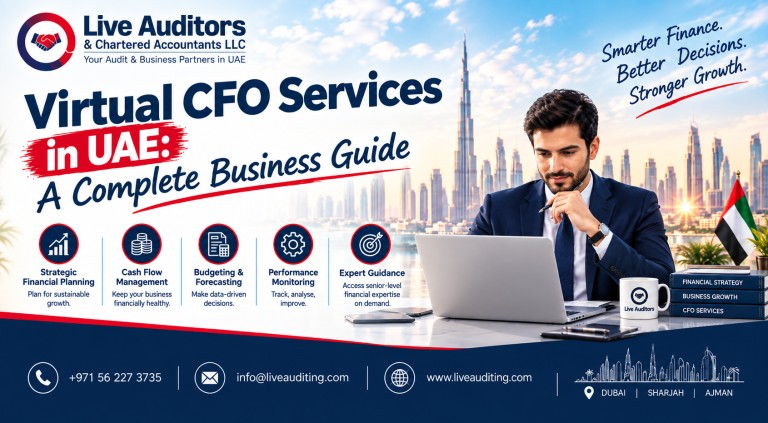
A virtual CFO is a senior finance professional — or a team led by one — who delivers CFO-level strategy, reporting, and financial decision support remotely, on a part-time or retainer basis, instead of as a full-time in-house hire. The work is the same in substance as what an internal CFO would do: financial planning, forecasting, cash flow management, risk assessment, and reporting to owners or the board. What changes is the delivery model — you get senior expertise on a schedule that matches your actual need for it, rather than paying for a full-time seat five days a week.
It’s worth separating two terms that get used almost interchangeably in the UAE market. A virtual CFO typically delivers this support remotely, using cloud accounting tools, video calls, and shared dashboards. An outsourced CFO, more broadly, describes having the CFO function handled by an external firm — which can include both remote and in-person engagement depending on what the business needs, such as attending board meetings or sitting in on audit discussions. In practice, most providers in the UAE blend the two, offering remote support as the default with in-person time built in where it matters.
What Does a Virtual CFO Actually Do?
The scope varies by engagement, but a virtual CFO’s work in the UAE generally covers six core areas:
Financial Planning & Strategy — Building a financial roadmap that’s actually aligned to where the business is trying to go, not a generic template.
Budgeting & Forecasting — Turning historical numbers into a forward-looking plan, so spending decisions are made against a real forecast rather than a gut feeling.
Cash Flow Management — Managing the cash operating cycle: collections, payment terms, and working capital, so cash flow becomes more predictable instead of a monthly surprise.
Risk Management — Identifying fiscal exposures — weak internal controls, concentration risk, currency exposure — before they turn into operational problems.
Financial Reporting — Producing accurate, timely statements of financial position and performance for owners, investors, or regulators, and managing communication with external auditors.
Cost Control & Investment Guidance — Finding where spending can be optimised without cutting into quality, and providing informed input on capital allocation for expansion or major purchases.
In a UAE-specific context, this list usually extends to VAT and corporate tax planning, since compliance now touches nearly every operating decision a business makes — from how contracts are structured to how intercompany transactions are priced.
|
Function |
Virtual CFO |
|
|---|---|---|
|
Records transactions |
Yes |
Not typically day-to-day |
|
Prepares VAT/tax filings |
Yes (compliance-focused) |
Oversees strategy, works alongside tax team |
|
Builds financial forecasts |
Rarely |
Core responsibility |
|
Advises on expansion decisions |
Rarely |
Core responsibility |
|
Manages cash flow strategy |
Rarely |
Core responsibility |
|
Reports to board/investors |
Rarely |
Core responsibility |
|
Cost |
Lower, ongoing |
Retainer or project-based, scaled to need |
Why UAE Businesses Are Turning to Virtual CFO Services
The UAE’s SME sector has expanded quickly, and the numbers explain a lot of the current demand for outsourced financial leadership. Small and medium-sized enterprises make up roughly 63.5% of the UAE’s non-oil GDP, and account for around 95% of the total number of companies operating in UAE markets. Separately, active SME licences in the UAE have risen by more than 140% compared with 2020, and by over 900% compared with 2000, reflecting a national push to strengthen the entrepreneurship ecosystem.
That growth has created a large population of businesses that have outgrown basic bookkeeping but aren’t yet at the size — or revenue — where a full-time, in-house CFO makes financial sense. A few forces are pushing these businesses toward the virtual model specifically:
- Corporate tax and VAT complexity — since the UAE introduced corporate tax, financial decisions increasingly have compliance implications, and businesses need someone who understands both the strategy and the regulatory side.
- Investor and bank expectations — businesses raising capital or seeking credit lines are expected to produce forecasts and reporting that a bookkeeper typically isn’t equipped to build.
- Cost of a full-time CFO hire — a qualified, experienced CFO in Dubai commands a significant salary plus benefits, which is difficult to justify for a business that doesn’t yet need five full days a week of that expertise.
- Multi-emirate and free zone complexity — businesses operating across Dubai, Abu Dhabi, Sharjah, and various free zones often need consolidated financial oversight that a single internal hire, unfamiliar with all the moving parts, may struggle to provide alone.
Benefits of Outsourcing CFO Services
Better financial visibility. Instead of only reviewing numbers when something goes wrong, owners get clear, regular reporting that shows the real financial position at any point in time.
Improved cash flow management. More predictable working capital, with fewer surprises around payroll or supplier payment cycles.
Stronger forecasting. Planning that’s grounded in actual financial data rather than assumptions carried over from the previous year.
Cost control. A structured view of where spending can be optimised without compromising operations.
Reduced financial risk. Earlier visibility into cash flow gaps, weak controls, or reporting issues — before they escalate into something harder to fix.
Scalable expertise. Access to CFO-level input as the business grows, without committing to a full-time executive role before it’s actually needed.
How Much Do Virtual CFO Services Cost in the UAE?
Pricing for virtual CFO services in the UAE isn’t standardised — it depends on business size, the scope of support required, reporting complexity, and how the engagement is structured (retainer, project-based, or fractional hours per month). A business that needs monthly reporting and quarterly forecasting will pay less than one that needs weekly board reporting, active audit support, and cross-border tax structuring advice.
As a general rule, the cost of a virtual CFO engagement sits well below the fully loaded cost of a full-time in-house CFO — which in the UAE includes not just salary, but visa sponsorship, benefits, and the overhead of a senior full-time seat. Most providers offer a consultation first to understand the scope before quoting, since pricing built on a generic package rarely reflects what a specific business actually needs.
Who Needs a Virtual CFO?
Not every UAE business needs full CFO-level support immediately. It typically becomes worth considering when a business is:
- Managing cash flow, reporting, or growth planning that’s become more complex than a bookkeeper alone can handle
- Preparing for a funding round, bank facility, or investor due diligence
- Expanding into new markets, emirates, or business lines and needing financial modelling to support the decision
- Facing new corporate tax or VAT obligations that touch pricing, structuring, or intercompany transactions
- Seeing inconsistent cash flow or profitability that isn’t explained by the monthly bookkeeping reports
- Growing fast enough that ad hoc financial decisions are starting to create risk
A fractional or virtual CFO model is often the practical fit at exactly this stage — before the business is large enough to justify a full-time executive hire, but past the point where basic accounting answers the questions ownership actually has.
How to Choose a Virtual CFO Provider in the UAE
A few questions are worth asking before signing an engagement:
- Do they understand UAE-specific compliance? Corporate tax, VAT, and free zone regulations differ from what a CFO trained in another market would default to.
- What’s actually included? Ask for a clear scope — reporting frequency, forecasting cadence, and whether audit support and tax coordination are part of the engagement.
- Who’s doing the work? Some providers assign a named senior professional; others rotate staff. Consistency matters for a role this central to decision-making.
- Can they scale with you? A good virtual CFO relationship should be able to expand in scope as the business grows, rather than requiring a full switch to a new provider later.
- Do they work alongside your existing accounting and audit team, or does the engagement require replacing what you already have in place?
Virtual CFO vs. Hiring a Full-Time CFO
For businesses weighing the two options, the decision usually comes down to stage and volume of need rather than a fixed rule. A full-time CFO makes sense once a business has enough financial complexity — multiple entities, active fundraising, significant headcount, or board-level reporting demands — to occupy someone’s full attention. Below that threshold, a virtual CFO typically delivers the same strategic input at a fraction of the cost, without the long-term commitment of a full-time executive hire. Many businesses use the virtual model as a bridge, then transition to an in-house hire once the workload genuinely justifies it.
Final Thoughts
Virtual CFO services have become a practical answer for UAE businesses that have grown past what bookkeeping alone can support, but aren’t yet ready for — or don’t need — a full-time finance executive. Done well, the engagement gives owners the same financial clarity and strategic input a large company gets from its internal CFO, scaled to fit a growing business’s actual size and budget.
If your business needs clearer financial visibility, better cash flow management, or strategic planning support, Live Auditors & Chartered Accountants LLC provides CFO advisory services across Dubai, Abu Dhabi, and Sharjah, built around your specific business rather than a generic package.
Frequently Asked Questions
1. What does a virtual CFO do?
A virtual CFO oversees financial strategy, reporting, budgeting, forecasting, cash flow, and risk management remotely — helping business owners make informed financial decisions rather than just recording past transactions.
2. How much does a virtual CFO cost in the UAE?
Costs vary depending on business size, scope of support, reporting complexity, and engagement model. Most providers quote after an initial consultation rather than using a fixed package price.
3. What is the difference between a virtual CFO and an outsourced CFO?
A virtual CFO delivers support remotely, while “outsourced CFO” more broadly describes having CFO functions handled by an external firm, which may include both remote and in-person engagement depending on the business’s needs.
4. Do small businesses in the UAE need a CFO?
Not every small business needs full CFO-level support, but many benefit from it once they’re managing more complex cash flow, reporting, or growth planning than a bookkeeper alone can handle.
5. Is a virtual CFO worth it for a startup?
For startups preparing to raise funding or scale quickly, a virtual CFO can provide the forecasting, reporting, and financial structure investors expect — often before the business can justify a full-time hire.
6. How is a virtual CFO different from an accountant?
An accountant typically focuses on recording transactions and compliance filings. A virtual CFO builds forecasts, advises on strategic decisions, and manages cash flow and risk at a higher level.
7. Can a virtual CFO help with corporate tax in the UAE?
Yes. CFO advisory support typically includes financial input on how corporate tax and VAT obligations affect pricing, structuring, and business decisions, often working alongside a dedicated tax team.
8. What qualifications should a virtual CFO have?
Look for demonstrated experience in your industry, familiarity with UAE tax and regulatory requirements, and a track record of supporting businesses of a similar size and structure.
