

Updated November 2026 · 5 min read
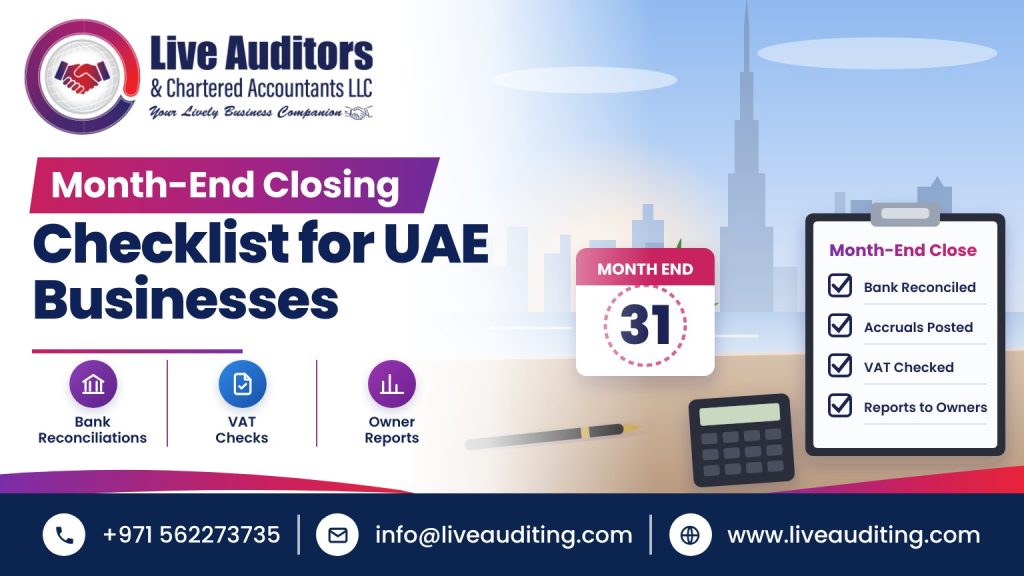
A month-end closing checklist turns a stressful scramble into a routine your team can finish in a few days. Without one, errors pile up quietly until the VAT return, the corporate tax filing or the year-end audit forces them into the open. Below is the checklist we recommend to UAE owners and finance managers, whether you run the close in-house or rely on accounting and bookkeeping services in Dubai to do it for you.
Why a Month-End Closing Checklist Matters in the UAE
Since corporate tax arrived, the UAE expects businesses to keep accurate books that can back up every figure in a return. VAT has demanded the same discipline since 2018. A monthly close is how you meet those expectations without a year-end panic.
It also gives you better decisions. A trading company in Deira that closes its books by the tenth of each month knows its margins while there is still time to act. A company that closes once a year only learns what went wrong after the money is gone.
Finally, a clean monthly close makes the annual audit shorter and cheaper. Auditors spend less time chasing balances that nobody has looked at for eleven months.
Step One Is Locking the Period and Gathering Documents
Start by setting a cut-off date. Anything dated on or before the last day of the month belongs in that month, and anything after it waits. Tell your sales and purchasing teams the deadline for submitting invoices, delivery notes and expense claims.
Then collect what you need in one place:
- Bank and credit card statements for every account, including foreign currency accounts
- Sales invoices, credit notes and delivery notes
- Supplier invoices and purchase orders
- Payroll reports and the WPS salary file
- Petty cash vouchers and staff expense claims
Once the period is complete, lock it in your accounting software so nobody can post back-dated entries by mistake.
Reconcile Every Balance Sheet Account
Reconciliation is the heart of the close. Each bank account should agree to the statement, with any difference explained by specific uncleared cheques or deposits in transit. Post-dated cheques, still common in the UAE, deserve a separate schedule so they are not recorded as cash too early.
Next, reconcile the customer and supplier ledgers to their control accounts. Compare major supplier balances with their statements and chase any differences while the transactions are still fresh.
Other accounts need attention too. Check that petty cash on hand matches the ledger, that inventory counts or estimates support the stock figure, and that loan balances match the bank’s confirmation. Review intercompany accounts with sister companies, and make sure both sides agree to the dirham.
Post Accruals, Prepayments and Adjustments
Under accrual accounting, expenses belong to the month in which they are incurred, not the month in which they are paid. Accrue for utilities, professional fees and services received without an invoice. Spread annual costs such as trade licence renewals, office rent and insurance across the months they cover.
Then post the recurring adjustments. These include monthly depreciation on fixed assets, the accrual for employees’ end-of-service gratuity, and accrued leave and air ticket entitlements where your contracts provide them. Revalue foreign currency balances at the month-end rate if you hold euro or dollar accounts.
Keep each journal supported by a short working paper. When an auditor asks why rent expense moved, you want the answer in a folder, not in someone’s memory.
Run Your VAT and Corporate Tax Checks
Month-end is the right time to keep tax figures honest, even if your VAT return is quarterly. Reconcile output VAT in the ledger to your sales register and input VAT to your purchase register. Confirm that every claimed purchase has a valid tax invoice and that blocked items, such as most entertainment costs, are excluded.
Watch for reverse charge entries on imported services, which are easy to miss. Check that zero-rated exports have the customs or shipping evidence to support them.
For corporate tax, tag non-deductible expenses as you go. Fines, penalties and some client entertainment are easier to identify monthly than at year-end. These monthly checks also feed straight into internal and external audit services in UAE, because auditors can test a well-documented close far faster.
If your firm uses outsourced accounting and bookkeeping services in Dubai, ask them to show you these reconciliations each month rather than only the final profit figure.
Review the Numbers and Report
Before you share anything, step back and read the results. Compare this month with last month and with budget. Ask simple questions. Why did revenue drop by a fifth? Why did utilities double? Most errors show up as an odd movement that nobody can explain.
Then produce a short management pack: a profit and loss account, a balance sheet, a cash flow summary and a list of aged receivables. Owners of small businesses do not need fifty pages. They need five numbers they trust and a sentence on what changed.
Finally, record what went wrong during the close and fix the cause. If supplier invoices always arrive late, change the process rather than chasing them every month. Global bodies such as the International Federation of Accountants publish useful guidance on financial reporting quality for small firms.
Making the Close a Habit
A good close takes three to seven working days for most SMEs. The first few months will be slower while you build schedules and templates. After that, the checklist does the thinking and your team simply works through it.
Give every task a named owner and a due day, such as bank reconciliations by day two and the management pack by day six. Keep the checklist in a shared file and tick items off as they finish. A reviewer, whether the owner or a senior accountant, should sign off before the period is locked. That small habit catches more errors than any software feature.
If you would rather have specialists run the process, our accounting and bookkeeping services in Dubai cover monthly closing, reconciliations and management reporting for businesses across Dubai, Sharjah and Ajman.
Contact us on +971 56 227 3735 or email info@liveauditing.com to set up a monthly close that keeps your books ready for tax and audit.
Frequently Asked Questions
1. How long should a month-end close take for a small business?
Most small and medium businesses can close their books within three to seven working days after month end. The first few closes usually take longer while templates and reconciliations are built. Once the process is routine, delays mostly come from late supplier invoices or missing bank statements rather than the accounting work itself.
2. What are the main steps in a month-end close?
The main steps are setting a cut-off date, collecting documents, reconciling bank and ledger balances, posting accruals and prepayments, booking depreciation and payroll adjustments, checking tax figures, and reviewing the results. The final step is producing management reports that explain how the month compares with the previous month and the budget.
3. Do UAE businesses have to close their books every month?
There is no specific law requiring a monthly close, but UAE businesses must keep accurate records that support their VAT and corporate tax returns. Closing monthly is the most practical way to meet that requirement. It also makes quarterly VAT returns, annual tax filings and statutory audits faster and less likely to contain errors.
4. What is a bank reconciliation and why does it matter?
A bank reconciliation compares the cash balance in your accounting records with the balance on the bank statement and explains every difference. It matters because it catches missing entries, duplicate payments, bank charges and fraud early. In the UAE it also helps track post-dated cheques, which should not be recorded as cash until they clear.
5. Which accruals are common at month end in the UAE?
Common month-end accruals in the UAE include utilities, telecom charges, professional fees, and services received without an invoice. Employers also accrue end-of-service gratuity, annual leave and air ticket entitlements where contracts provide them. Prepayments such as rent, insurance and trade licence fees are spread across the months they cover instead of being expensed at once.
