

Updated November 2026 · 5 min read
Tax invoice requirements under UAE VAT law go into more detail than many businesses realise. An invoice that misses a required field is not just untidy. It can stop your customer from recovering input tax, and it can expose you to administrative penalties during an FTA audit. As mandatory e-invoicing rolls out, the details matter even more. This guide sets out what a valid tax invoice must contain, when it must be issued and how to handle corrections, along with where VAT consultants in Dubai can help tighten your process.
Who Must Issue a Tax Invoice
Every VAT registered business must issue a tax invoice when it makes a taxable supply. That includes standard-rated supplies at 5% and, in most cases, zero-rated supplies too.
The FTA allows a different document, or none at all, only in a few narrow exceptions. As a general rule, if you hold a VAT registration and charge VAT, your customer should receive a tax invoice.
Exempt supplies, such as residential rent or certain financial services, do not require a tax invoice because they carry no VAT. Many businesses still issue a commercial invoice for those sales for their own records.
Full Tax Invoice Requirements
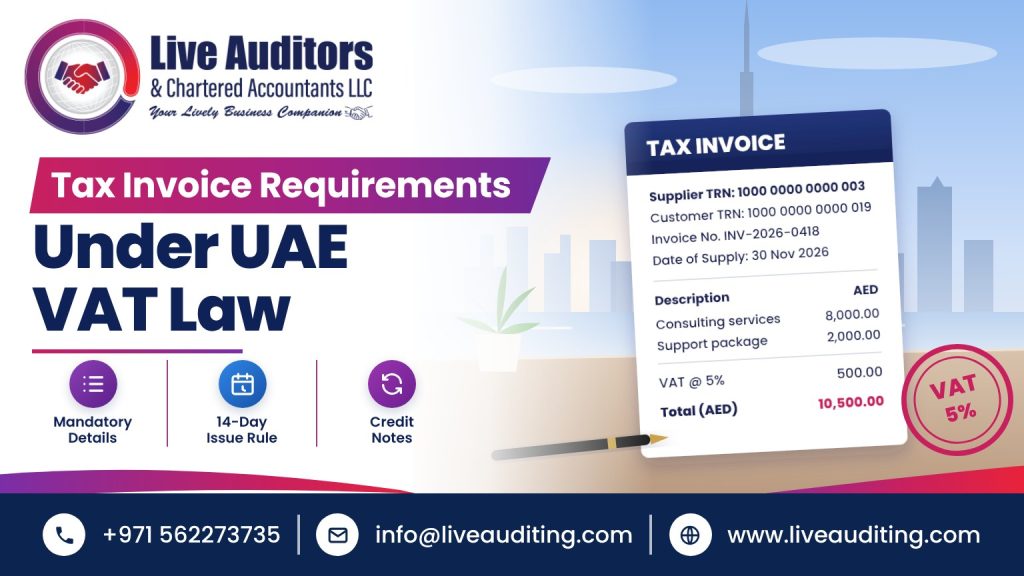
A full tax invoice must include a specific set of details. In summary, it should show:
- The words “Tax Invoice” clearly displayed
- The supplier’s name, address and Tax Registration Number
- The recipient’s name, address and Tax Registration Number, where the recipient has one
- A sequential invoice number that uniquely identifies the invoice
- The date of issue, and the date of supply if different
- A description of the goods or services supplied
- The unit price, quantity, applicable VAT rate and amount payable for each item
- Any discount offered
- The gross amount payable
- The total VAT amount, shown in UAE dirhams
- A statement that the reverse charge applies, where relevant
Each field has a purpose. The TRNs let the FTA match supplies and purchases across businesses, and the sequential number makes gaps or duplicates visible. A missing recipient TRN on a large B2B invoice is a very common problem.
When You Can Use a Simplified Tax Invoice
A simplified tax invoice contains fewer details. You can generally use one where the recipient has no VAT registration. You can also use one where a registered recipient’s supply does not exceed AED 10,000.
Retailers, restaurants and cafés usually issue simplified invoices at the till. A simplified invoice still needs the words “Tax Invoice”, the supplier’s name, address and TRN, a sequential number, the date, a description, the total amount and the VAT charged, or a statement that the total includes VAT at the stated rate.
If a registered business customer asks for a full tax invoice for a larger purchase, you should provide one.
In practice, the safest approach is to configure your point of sale or billing system so that it can produce both formats. A building materials trader in Ajman, for example, may sell to walk-in customers and to registered contractors on the same day. The till should issue simplified invoices by default, with an easy way to generate a full invoice that captures the contractor’s name, address and TRN.
Timing, Currency and Language
A tax invoice must generally be issued within 14 days of the date of supply. The date of supply is the tax point, which is usually the earliest of delivery, receipt of payment or issue of the invoice, with special rules for continuous supplies.
The invoice must show the VAT amount in UAE dirhams. If you invoice in US dollars or euros, convert the VAT using the exchange rate approved by the UAE Central Bank for that date.
Most businesses issue invoices in English, although the FTA can ask for an Arabic translation of records. The FTA accepts electronic invoices that meet the content and record-keeping rules. Under the e-invoicing framework, many businesses will move to structured electronic invoices exchanged through accredited providers, starting with larger businesses.
Tax Credit Notes and Corrections
Sometimes the value of a supply changes after invoicing, perhaps because of returns, a price cut or a cancellation. In that case, the correct document is a tax credit note.
A tax credit note should show the words “Tax Credit Note”, the supplier and recipient details, the date, a reference to the original tax invoice, the value of the supply shown on the original invoice, the difference and the VAT adjustment in UAE dirhams, and a brief explanation.
Do not simply cancel and reissue invoices in your system without a clear audit trail. The FTA expects to see the original document and the correction. Strong accounting and bookkeeping services in Dubai make this straightforward, because every adjustment is recorded, numbered and linked to the original sale.
Penalties and Common Invoice Errors
Failing to issue a tax invoice or credit note, or issuing one that does not meet the requirements, can lead to administrative penalties. The FTA typically charges these per document, so a systemic error in an invoice template can multiply quickly across thousands of invoices.
The most common errors are:
- Templates missing the words “Tax Invoice” or the supplier’s TRN
- VAT shown only in a foreign currency
- Non-sequential numbering after a system migration
- Simplified invoices used for large B2B sales
- Invoices issued months after the supply date
A periodic sample check catches most of these. Experienced VAT consultants in Dubai can review your templates and a sample of real invoices against the legal checklist in a short engagement.
Making Every Invoice Count
A compliant invoice protects you and your customer. Use the right type of invoice, include every required field, issue it within 14 days, show VAT in dirhams and correct errors through proper credit notes. As e-invoicing arrives, these basics become the foundation for structured data that systems will check automatically. If you want your templates and processes reviewed before that happens, our VAT consultants in Dubai can help.
The full legislation and FTA guides on invoicing are available from the UAE Federal Tax Authority.
Contact us on +971 56 227 3735 or email info@liveauditing.com to check your tax invoice requirements and templates.
Frequently Asked Questions
1. What must a UAE tax invoice include?
A full UAE tax invoice must show the words Tax Invoice, the supplier’s name, address and TRN, the recipient’s details and TRN where registered, a sequential number, dates, a description, unit prices, quantities, the VAT rate, any discount, the gross amount and the total VAT in UAE dirhams.
2. When can I issue a simplified tax invoice?
You can generally issue a simplified tax invoice when the customer has no VAT registration. The same applies when a registered customer’s supply does not exceed AED 10,000. It needs fewer details than a full invoice but must still show the supplier’s TRN, a sequential number, the date and the VAT charged.
3. How many days do I have to issue a tax invoice?
A tax invoice must generally be issued within 14 days of the date of supply. The date of supply is usually the earliest of delivery, payment or invoice issue, with special rules for continuous supplies. Late invoices can lead to administrative penalties and problems for customers recovering input tax.
4. Can you issue a tax invoice in US dollars?
Yes, you can issue the invoice in another currency, but it must also show the VAT amount in UAE dirhams. Convert it using the exchange rate approved by the UAE Central Bank on the date of supply. Showing VAT only in a foreign currency is a common compliance error.
5. How do I correct a tax invoice in the UAE?
Issue a tax credit note rather than deleting or overwriting the original invoice. The credit note should reference the original invoice, show the original value, the adjustment and the VAT difference in UAE dirhams, and briefly explain the reason. Keep both documents as part of your VAT records.
