

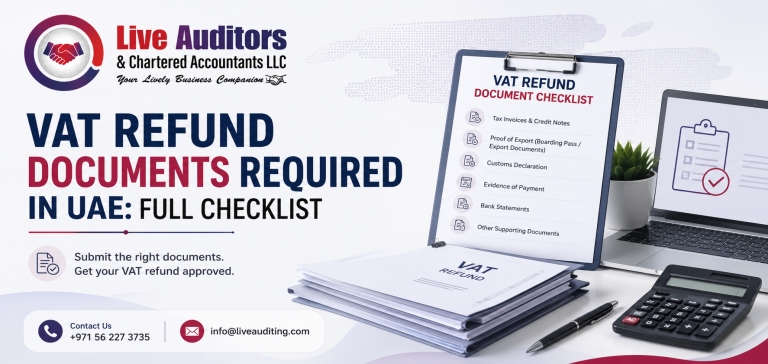
Discover the VAT Refund Documents required in UAE to file a successful FTA claim. Use this checklist to avoid rejections and stay fully compliant.
Submitting the right VAT Refund Documents is the single most critical factor that determines whether your UAE VAT refund claim gets approved or rejected by the Federal Tax Authority (FTA). Moreover, even businesses with legitimate input tax credits lose their claims simply because their documentation does not meet FTA standards. In this article, we provide a complete, practical checklist of every document you need — so you can file with confidence. If you are new to this topic, we recommend reading our earlier guide on VAT Refund UAE: Complete Guide for Businesses before proceeding.

Why VAT Refund Documents Determine the Success of Your Claim
The FTA does not approve refund claims based on good intentions or accounting entries alone. Therefore, every dirham of input tax you claim must be traceable to a physical or digital document that satisfies UAE VAT law requirements. In practice, the FTA has the authority to request supporting evidence at any stage — during processing, post-approval, or as part of a full tax audit.
Moreover, incomplete or non-compliant documents do not just delay your refund — they can trigger penalties, audit flags, and in serious cases, rejection of future claims. As a result, treating your VAT documentation as an ongoing compliance function — not a last-minute filing task — is the only sustainable approach for UAE businesses.
Core VAT Refund Documents Every UAE Business Must Prepare
The following documents form the foundation of any VAT refund submission in the UAE. In addition, these apply across most business types and industries — from trading companies to professional service firms.
1. Valid Tax Invoices from Suppliers
A tax invoice is the primary document supporting every input VAT claim. However, not all invoices qualify. For an invoice to be valid under UAE VAT law, it must include:
- The word “Tax Invoice” clearly stated
- Supplier’s full legal name and address
- Supplier’s Tax Registration Number (TRN)
- Invoice date and a unique sequential invoice number
- Description of goods or services supplied
- Net amount, VAT rate applied (5%), and VAT amount stated separately
- Total amount payable including VAT
- Buyer’s name and TRN (for invoices above AED 10,000)
Therefore, any invoice missing even one of these elements is technically non-compliant and the FTA will not accept it as valid support for input tax recovery.
2. Proof of Payment
In addition to holding a valid tax invoice, you must demonstrate that payment was actually made. The FTA generally requires bank statements, remittance advices, or payment confirmation records that match the invoice amount and supplier details. For example, a tax invoice without a corresponding payment trail raises immediate questions about whether the transaction genuinely occurred.
3. VAT Return Filing Records (VAT 201)
Your filed VAT 201 return forms the formal basis of your refund request. As a result, the figures in your VAT return must reconcile exactly with your accounting records and supporting invoices. Discrepancies between your return and your books are one of the most common reasons the FTA issues a query or initiates an audit.
Industry-Specific VAT Refund Documents in UAE
Beyond the core documents, specific industries and transaction types require additional evidence. In practice, the FTA applies heightened scrutiny to high-value and cross-border transactions. Therefore, businesses in the following categories must ensure they have the right supplementary documentation ready.
For Importers and Trading Companies
- Customs Import Declaration (Bill of Entry): Issued by UAE Customs, this document confirms VAT was paid at the point of import and is essential for recovering import VAT
- Commercial Invoice from Overseas Supplier: Must match the customs declaration in value and description
- Packing List and Bill of Lading / Airway Bill: Confirms shipment details and supports the legitimacy of the import transaction
For Exporters Claiming Zero-Rated Input Tax Recovery
- Export Customs Declaration: Official UAE Customs document confirming goods left the country
- Airway Bill, Bill of Lading, or Freight Forwarder Certificate: Proof of physical export
- Customer Purchase Orders and Sales Contracts: Demonstrates the commercial basis of the zero-rated supply
- Proof of Receipt by Overseas Customer: Delivery confirmation or acknowledgment where available
For Businesses with Capital Expenditure Claims
- Asset Purchase Invoices: Full tax invoices for equipment, machinery, fit-out costs, or technology purchases
- Depreciation Schedules and Fixed Asset Register: Confirms the asset is in use for taxable business activities
- Contracts and Payment Schedules: For staged payments on large capital projects
For UAE Nationals Claiming Refund on New Residences
- Title deed or property ownership documents
- Emirates ID and passport copy
- Contractor tax invoices for construction costs
- Completion certificate issued by the relevant authority
- Proof that the property is a new build and intended for personal residential use
This category is governed by specific FTA criteria, and businesses should assess eligibility carefully before submitting. For full guidance, refer to the Federal Tax Authority’s official portal.

Additional VAT Refund Documents the FTA May Request
In addition to the primary documents listed above, the FTA may request the following during its review process — particularly for larger refund claims or where the business is under audit:
- General Ledger and Trial Balance: To verify that VAT figures in the return match your accounting system
- VAT Audit File (VAF): A structured data file extracted from your accounting software summarising all VAT transactions for the period
- Supplier Agreements and Service Contracts: For recurring or high-value vendor relationships
- Employee Expense Claims: If claiming VAT on business travel or approved staff expenses
- Intercompany Transaction Records: For group companies, transfer pricing documentation and intercompany invoices may be required
- Correspondence with Suppliers or Customers: In disputed or complex transactions, email or contract evidence may be requested
Moreover, the FTA expects all records in Arabic or English. Therefore, documents in other languages must come with a certified translation where necessary.
VAT Refund Document Mistakes That Cause Claim Rejection
- Using proforma invoices instead of tax invoices: Proforma invoices are not valid for VAT input tax claims under UAE law
- Missing supplier TRN on invoices: This single omission invalidates the entire invoice for VAT recovery purposes
- Cash payments for large transactions: Payments above AED 10,000 in cash are not recommended and may face scrutiny from the FTA
- Mismatch between invoice currency and payment currency: Ensure exchange rates are documented and consistent with your accounting records
- Claiming VAT on invoices addressed to a related party: Input tax is only recoverable on invoices addressed to the registered taxable entity making the claim
- Missing export proof for zero-rated claims: Without customs and shipping documentation, zero-rated export claims are difficult to substantiate
- Incomplete VAT Audit File: Submitting a VAF that does not reconcile with filed returns is a significant compliance risk
How Long Must You Retain VAT Refund Documents in the UAE?
Under UAE VAT regulations and the Ministry of Finance guidelines, businesses must retain all VAT-related records for a minimum of five years from the end of the relevant tax period. However, for real property transactions, the retention period extends to fifteen years. Therefore, businesses should implement a structured document management system — whether physical or digital — that allows rapid retrieval during an FTA audit or query.
In practice, cloud-based accounting platforms and digital document storage solutions significantly reduce the risk of record loss and make compliance far easier to maintain over time.
How We Can Help
At Live Auditors & Chartered Accountants LLC, we help UAE businesses build audit-ready VAT documentation systems, review existing records for compliance gaps, and prepare complete refund submissions that align with FTA expectations. Our team conducts pre-submission document reviews to identify missing or non-compliant invoices before they become a problem.
We do not guarantee specific outcomes — however, a structured, documentation-first approach to VAT refund claims significantly reduces the risk of rejection or FTA follow-up. Businesses should assess their readiness before submitting any claim.
Need professional guidance?
Email: auditors@liveauditing.com
Website: liveauditing.com
Frequently Asked Questions (FAQs)
Can I claim a VAT refund using a simplified invoice instead of a full tax invoice?
Simplified tax invoices — permitted for transactions under AED 10,000 — may be used for input tax recovery. However, they must still include the supplier’s TRN, date, description, and VAT amount. For higher-value transactions, a full tax invoice is mandatory.
What if my supplier refuses to issue a compliant tax invoice?
Under UAE VAT law, every VAT-registered supplier must issue a compliant tax invoice upon request. If a supplier refuses or issues a non-compliant invoice, you should escalate the matter formally. In some cases, reporting the issue to the FTA may be necessary, as the supplier may be in breach of their tax obligations.
Are digital or scanned invoices accepted by the FTA?
Yes. The FTA generally accepts digital invoices and scanned copies, provided they are legible and contain all required information. Moreover, electronic invoices from compliant accounting systems are fully acceptable as long as they meet the content requirements under UAE VAT law.
Do I need to submit all documents upfront when filing a refund request?
Not necessarily. When you submit a VAT refund request through EmaraTax, the FTA may initially review your return data and subsequently request specific supporting documents. However, you must have all records ready before filing — because if you cannot produce them on request, your claim may face delay or rejection.
What is a VAT Audit File and Is It a Required VAT Refund Document?
A VAT Audit File is a structured data export from your accounting system that summarises all VAT transactions for a given period. The FTA may request it during an audit or as part of a refund review. While it is not always submitted upfront, businesses should ensure their accounting software — such as TallyPrime or similar — can generate a compliant VAF on demand.
Disclaimer
This article is for general informational purposes only and does not constitute tax, legal, or professional advice. The application of UAE tax laws may vary depending on specific facts and circumstances.